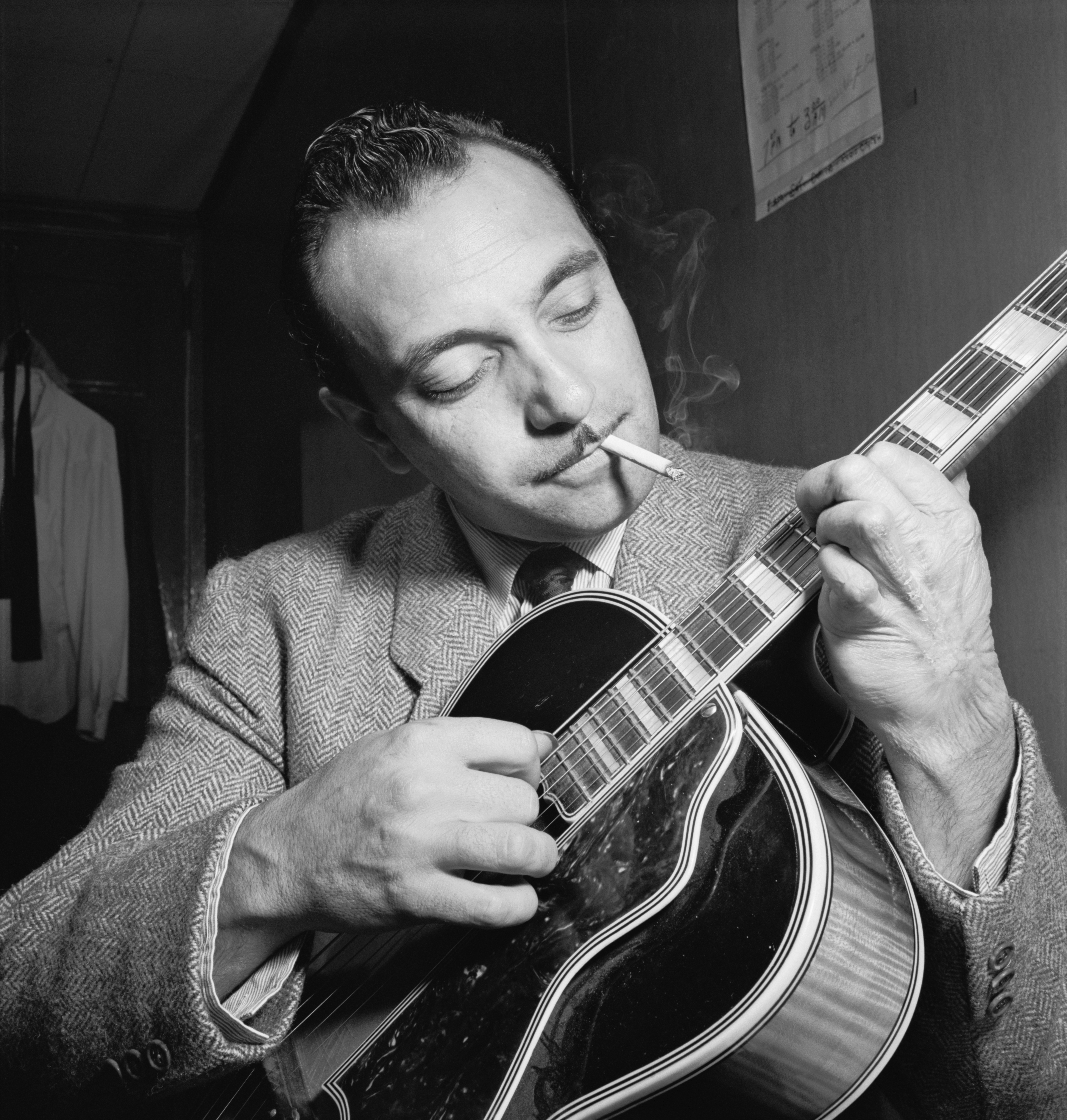
Biography
Django Reinhardt, born in 1910 in Bellegarde, France, emerged from humble beginnings to become one of the most influential jazz guitarists of all time. His early career was marked by a tragic accident at the age of 18 that left him with limited use of two fingers on his left hand. Nevertheless, he developed a unique fingerstyle technique that allowed him to craft melodies that weaved seamlessly with the rhythm. Django's early performances were often in small clubs in Paris, playing alongside a variety of musicians who would soon help shape his career. His most notable early work included forming the band 'Quintette du Hot Club de France' in 1934 alongside violinist Stéphane Grappelli, which played a quintessential role in establishing the gypsy jazz genre. Throughout his career, Django was known for his exceptional improvisation skills and distinctive sound. The Quintette du Hot Club de France gained international acclaim for their innovative blend of jazz, gypsy, and folk music, producing timeless tracks like 'Minor Swing' and 'Djangology.' His collaboration with Grappelli and others led to numerous recordings that defined the sound of jazz in Europe throughout the 1930s and 40s, paving the way for future generations of guitarists. Despite the challenges posed by World War II, Django continued to perform, with his music resonating through both underground and mainstream channels. His major achievements included performances at pivotal jazz festivals and influential recordings that remain classics to this day. Django’s musical style was characterized by an energetic fusion of rhythm and melody, heavily influenced by European folk music and American jazz. His guitar technique was groundbreaking, utilizing rapid arpeggios and a unique picking style that set a new standard for guitarists. Django was famously associated with the Selmer Maccaferri guitar, particularly the 1933 Selmer Maccaferri Model 506 with a distinctive oval sound hole, which contributed significantly to his signature sound. His gear preferences also included a variety of amplifiers and effects that complemented his playing style, although specifics on brands might be less documented due to the time period he thrived in. Nonetheless, his skilled touch on the guitar and his innovative approaches made him an irreplaceable figure in the music world. Django Reinhardt's legacy continues to flourish, influencing countless musicians across genres, from jazz to rock and beyond. He passed away in 1953, but his recordings and the style he popularized live on, inspiring new waves of guitarists, notably including legends like Jimi Hendrix and modern players such as Stochelo Rosenberg. Today, Django's work remains a staple in the jazz repertoire, with annual festivals celebrating his life and music. His contributions to the art of guitar playing are universally recognized, cementing his status not just as a musician but as an enduring icon of musical innovation and cultural exchange.
Roles
Guitarist, Composer
Band History
Quintette du Hot Club de France, Various Collaborations
Signature Gear
Guitars: 1933 Selmer Maccaferri Model 506
Bandmates & Collaborators
Glen Matlock, Bruce Gary, Russell Javors, Tom Hobden, Alan Braxe, Ayo Olatunji, Sebastian Steinberg, Andrew T. Yng